
 FICA Tax Explained for Nonresident Aliens
You check your first U.S. paycheck and notice deductions for Social Security and Medicare. If you are a J-1 student, intern, trainee, camp counselor, or other nonresident worker, this can be alarming. Many nonresidents are not required to pay FICA tax at all, yet it is commonly withheld by mistake.
This guide explains what FICA tax is, when nonresident aliens are exempt, when FICA does apply, and what you can do if it was taken from your pay incorrectly.
What is FICA and why does it exist?
FICA stands for the Federal Insurance Contributions Act. It is the U.S. payroll tax that funds two major social insurance programs:
- Social Security, which provides retirement, disability, and survivor benefits
- Medicare, which provides health insurance primarily for people aged 65 and older and certain disabled individuals
Every time a U.S. employee is paid, a portion of their wages is withheld for these programs, and the employer contributes an equal amount.
You may see OASDI on your payslip. This is the Social Security portion of FICA.
How FICA works for employees
FICA is deducted automatically from wages through payroll.
For employees:
- 6.2 percent goes to Social Security
- 1.45 percent goes to Medicare
This totals 7.65 percent withheld from wages, with the employer paying the same amount.
For self employed individuals, a separate law called SECA applies, and the combined rate is higher.
FICA exemption for nonresident aliens
When nonresidents are exempt from FICA
Most nonresident aliens in the U.S. do not have to pay Social Security or Medicare tax if they are working under a qualifying visa and remain nonresidents for tax purposes.
FICA is generally not required on income earned from:
- On campus student employment within permitted hour limits
- Off campus employment authorized by immigration rules
- Practical training employment connected to student status
- Employment as a professor, teacher, or researcher within the initial exemption period
- Employment as a physician, au pair, summer camp worker, or similar J category roles within the initial exemption period
Visa types commonly exempt
Nonresident aliens in F, J, M, Q visa categories are generally exempt from FICA while they retain nonresident tax status and work in roles permitted by their visa.
FICA exemption periods for students and exchange visitors
Full time students
International students are typically exempt from FICA for:
- The first five calendar years of physical presence in the U.S. if they are full time students
Non students on J or Q visas
Non student exchange visitors are typically exempt for:
- The first two calendar years
After these periods, individuals may become resident aliens for tax purposes and FICA withholding may begin, depending on their situation.
OPT and CPT
Periods of authorized practical training usually count as part of the student exemption period, as long as the individual remains a nonresident for tax purposes.
When nonresidents must pay FICA
FICA exemption does not apply in certain situations, including:
- Spouses or dependents in F-2, J-2, M-2, or Q-3 status
- Employment that is not authorized or not closely related to the visa purpose
- A change to a non exempt immigration status
- Becoming a resident alien for tax purposes
- Exceeding the exemption period of two years for J and Q visas or five years for F and M students
In these cases, FICA withholding is usually required.
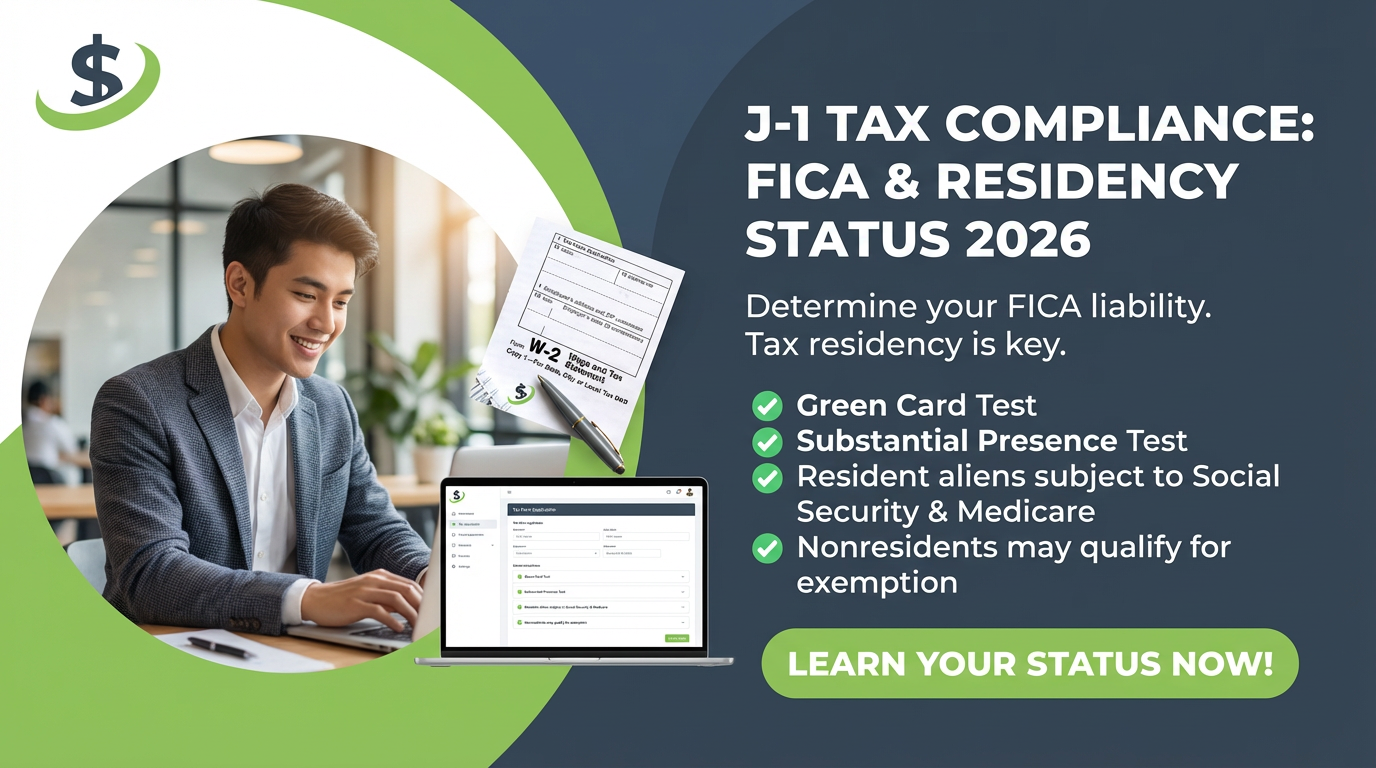
FICA and tax residency status
Tax residency is critical for determining FICA liability.
You are considered a resident alien for tax purposes if you meet either:
- The Green Card Test
- The Substantial Presence Test
Resident aliens are subject to Social Security and Medicare taxes in the same way as U.S. citizens. Nonresidents who do not meet these tests may qualify for exemption if their visa and employment meet the requirements.
FICA tax rates for 2026
For 2026:
- Total employee FICA rate is 7.65 percent
- 6.2 percent Social Security
- 1.45 percent Medicare
Social Security tax applies only up to a wage limit of $184,500 for 2026. Medicare has no wage limit.
What to do if FICA was taken from your pay by mistake
Incorrect FICA withholding is common for J-1 workers and other nonresidents.
Step one: contact your employer
Ask your employer or payroll department to refund the incorrectly withheld FICA. If a W-2 has already been issued, a corrected W-2C may be required.
Step two: claim from the IRS if needed
If your employer cannot refund the tax, you may still be able to claim it directly from the IRS by filing a FICA tax refund claim with supporting documents.
How long a FICA refund takes
FICA refunds are not quick. Processing often takes at least 12 weeks, and sometimes longer, depending on IRS workload. There is no online tracking system for FICA refunds. Status checks are done by phone once enough time has passed.
Final reassurance
If you are a nonresident alien, paying FICA is often not required, but payroll systems frequently apply resident rules by default. Understanding your visa status, tax residency, and exemption period helps you spot mistakes early and recover money that should not have been withheld. 5
Start using our services by selecting the right service for your case here: https://j1summertaxback.com/service-selector